Cavity Between Teeth: Early Signs, How Dentists Find It, and What Fixes It
A cavity between teeth is the one you cannot see, cannot feel and cannot reach with a toothbrush. That is why it so often shows up first on a dentist's X-ray.
The good news is that the earliest stage can still be reversed. The harder news is that once the enamel has broken through, no rinse, toothpaste or supplement will close the hole.
This guide covers why these cavities hide, the early signs worth knowing, how dentists find them, what fluoride can and cannot do, and when you need a filling.
Why a Cavity Between Teeth Hides So Well
Every cavity starts the same way. The American Dental Association's MouthHealthy site explains that plaque, a sticky film of bacteria, constantly forms on your teeth. After sugary foods and drinks, those bacteria make acids that wear down the enamel. Plaque's stickiness keeps the acid in contact with the tooth.
Between two teeth, that process has the perfect setting. The two surfaces face each other. A brush bristle reaches only part of the way into the gap. Food gets trapped there, and plaque sits undisturbed for days.
You also cannot see the spot. You look at the front of a tooth in the mirror, and the damage is on the side. Dentists call these interproximal or approximal cavities, meaning cavities on the surfaces between neighboring teeth.
Early decay rarely announces itself either. The NHS says tooth decay may not cause symptoms at first. Pain usually arrives later, when the damage has already gone deeper. A dentist who finds a cavity between teeth early is often looking at a tooth that feels perfectly normal to you.
Early Signs of a Cavity Between Teeth
Because the early stage is quiet, the signs below are clues rather than proof. None of them can confirm a cavity on its own. Only an examination and an X-ray can.
Food keeps catching in one spot
If food lodges between the same two teeth every time you eat, ask a dentist to look. A rough edge, a gap from a worn filling or a cavity can all create that trap. Our guide to getting rid of plaque covers how fast the film rebuilds in spots like this.
Floss shreds or snags
Floss that catches, frays or tears at one contact point can mean a rough surface or a rough edge. It can also mean a cavity. A gap that now holds more food than it used to is worth mentioning at your next visit.
A white, brown or black spot
The NHS lists white, brown or black spots on the tooth among the signs of decay. The National Institute of Dental and Craniofacial Research (NIDCR) describes the white spot as the visible sign of early decay. Spots between teeth are hard to see yourself, so a dentist is more likely to spot them than you are.
Sensitivity to cold, heat or sweets
The NHS names sharp pain when eating or drinking something hot, cold or sweet as a sign that decay has formed a hole. A twinge in one specific spot, rather than a general ache, is the pattern to watch for.
Toothache
Toothache is the NHS's other main sign. A cavity can reach this stage without much warning, so do not wait for pain before booking a check-up. Sudden pain with swelling is covered in the red-flag section below.
If gums between the teeth are also sore or bleed, that is a separate issue. Our guides on bleeding gums and swollen gums cover it.
How Dentists Find a Cavity Between Teeth
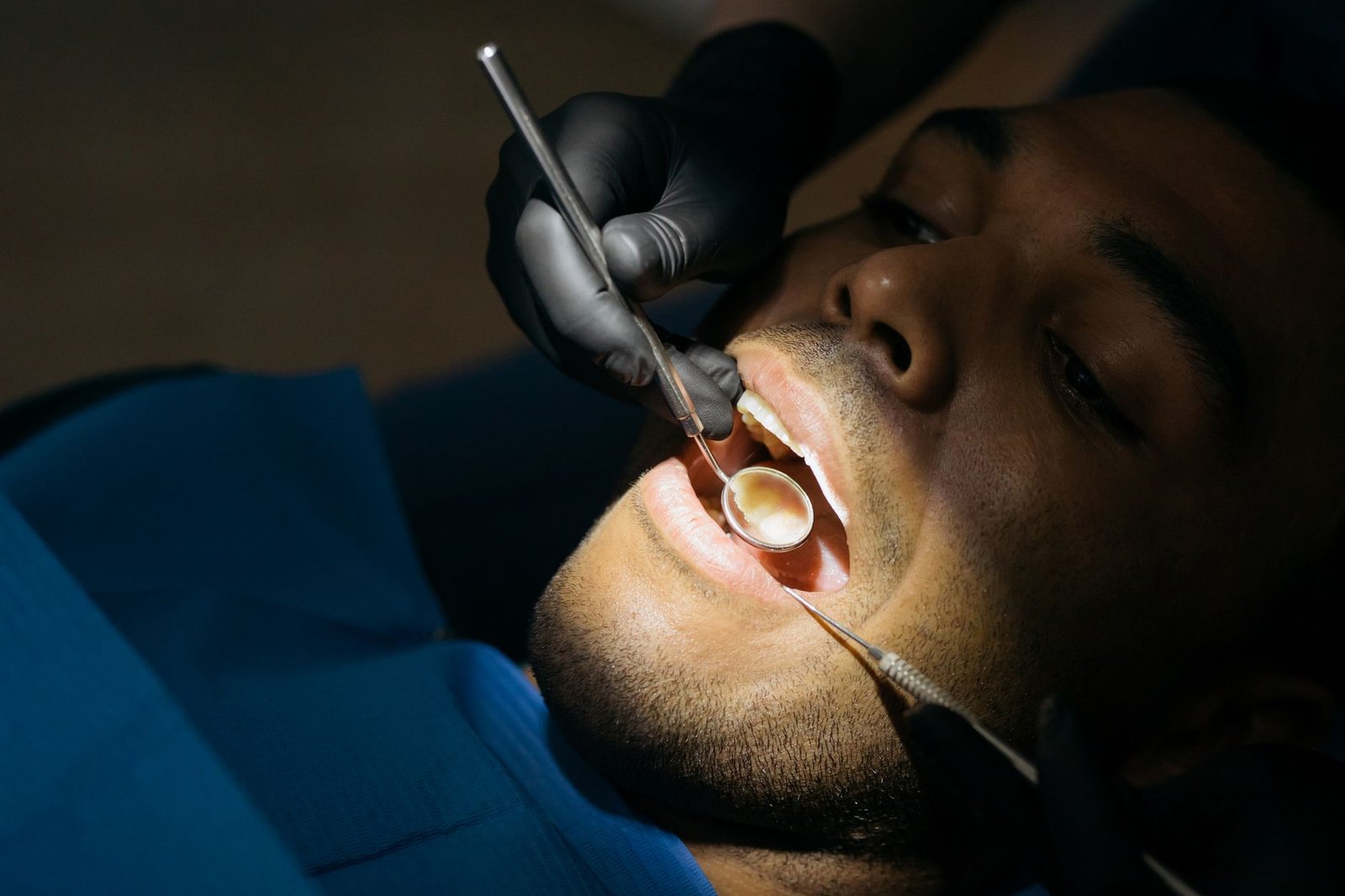
A dentist uses a mirror and a probe to check the surfaces they can see. Those tools cannot show the tight spot where two teeth touch. That is where X-rays come in.
Most routine checks use bitewing X-rays. You bite down on a small tab, and the X-ray beam passes through the gaps between your upper and lower back teeth. A 2022 trial in the Journal of Dental Sciences describes horizontal bitewings as very reliable for diagnosing cavities between teeth, because the beam angle lets clinicians examine the contact areas.
Reading an X-ray is still a judgment call. The same trial reports only modest agreement between observers when they looked for cavities, with weighted kappa values of roughly 0.25 to 0.51. It was a small study of 20 people, so treat that as a reminder that two dentists can read the same film slightly differently. It is not a reason to skip X-rays.
On a bitewing film, a dentist looks for a darker area where the tooth should look solid. Comparing it with earlier films helps show whether a spot is new or growing.
The NHS advises regular check-ups even if nothing hurts, and lists going two years without one as a reason to book. Your dentist will tell you the right schedule for your own mouth.
What Can Be Reversed and What Needs a Filling
This is the part most articles blur. A cavity between teeth is a spectrum, and the treatment depends on where it sits on that spectrum.
Stage 1: Mineral loss and the white spot
The NIDCR describes teeth as losing and regaining minerals all the time. Bacteria make acid and pull minerals out of the enamel. Saliva and fluoride put them back. When the loss outpaces the repair, a white spot can appear.
At this stage, the NIDCR says, decay can be stopped or reversed. Enamel can repair itself using minerals from saliva and fluoride, from toothpaste or from treatment a dentist applies. The NHS agrees that early decay may be reversed with fluoride treatments such as mouthwash or varnish.
Stage 2: The cavity
If the acid keeps winning, the enamel breaks down and a hole forms. The NIDCR describes this as permanent damage that needs a dentist to fill it. Fluoride cannot rebuild the missing tooth. It can only help protect the tooth around it.
Our guide on how to rebuild tooth enamel explains the same limit from the erosion side. Enamel that has been lost does not grow back.
Stage 3 and beyond: Deeper decay
The NHS lists the next steps. If decay reaches the pulp, the soft inner tissue of the tooth, root canal treatment is needed. A severely damaged tooth may have to be removed. Infection can also lead to a dental abscess, a painful collection of pus.
The takeaway is blunt. Each stage down the list costs more, hurts more and removes more of your tooth. A filling at the cavity stage is a small repair. A root canal is not.
Cleaning Between Teeth: What the Evidence Says
The ADA's advice is plain. Brush twice a day with fluoride toothpaste and clean between your teeth once a day with floss or another interdental cleaner. The ADA's floss page says floss, interdental brushes, picks and water flossers all remove food and plaque from between teeth, and that this helps lower the chance of gum disease and decay.
Here is what is less well known. The research does not prove that home flossing prevents cavities between teeth.
A 2019 Cochrane review looked at interdental cleaning devices. It reached these findings:
- Gum inflammation: floss added to brushing may reduce gingivitis in the short and medium term, with low-certainty evidence from 15 trials comparing floss plus brushing against brushing alone.
- Plaque: results for floss were inconsistent, so it is unclear whether it reduces plaque.
- Brushes versus floss: interdental brushes may reduce gingivitis more than floss at one and three months, also with low certainty.
- Cavities: the review states that no trials assessed interproximal caries.
The review rates the evidence as low to very low certainty, and the effects may not be clinically important.
The ADA adds one more piece. A meta-analysis found that regular professional flossing, five days a week, significantly reduced interproximal cavities. Professional flossing every three months and self-flossing did not show that effect.
So what should you do? Keep cleaning between your teeth, because it is cheap, low-risk and recommended by dental bodies. Just do not treat floss as a guarantee. Fluoride toothpaste, fewer sugary snacks and regular dental visits do real work here too. MouthHealthy also recommends limiting snacking and asking your dentist about sealants for the chewing surfaces of back teeth.
Make the habit stick
- Use a fresh section of floss for each gap, or a new pick. The ADA says to discard these devices after one use.
- Curve the floss around each tooth in a C shape. Do not snap it down onto the gum.
- If floss is hard for you to use, try an interdental brush or a water flosser, and ask your dentist which size suits your gaps.
- Spit out the toothpaste after brushing rather than rinsing, so the fluoride stays on the teeth longer.
- Skip sugary food and drinks after your bedtime brush. The NIDCR notes that saliva flow drops during sleep.
Our guide on how to stop tooth decay goes through these steps in more detail, including the NHS fluoride advice.
Supplements and Cavities: Setting Expectations
Gum and tooth supplements are heavily marketed, so it is worth saying clearly what they cannot do. No supplement fills a cavity, closes a hole in enamel or reverses decay that has reached dentin.
One product in this space is Dentitox Pro, a liquid used as drops on the teeth and gums. Its ingredient list includes xylitol, zinc, calcium and vitamins A, C, D3 and K2. As our full Dentitox Pro review explains, the vendor does not publish ingredient amounts, and there is no independent clinical trial on the formula itself.
That makes it, at most, an optional extra for someone who already brushes with fluoride, cleans between teeth and sees a dentist. It cannot replace a filling. The review also covers the $49 to $69 pricing and the 60-day money-back guarantee if you want the details.
When to See a Dentist or Doctor
Book a dental appointment soon if you notice any of these:
- Food that keeps packing into the same gap
- Floss that shreds or catches at one spot
- A new white, brown or black spot on a tooth
- Sharp pain with hot, cold or sweet food and drink
- A toothache, even one that comes and goes
- Gums that are painful, swollen or bleed when you brush
The NHS says to see a dentist as soon as possible if you think you have tooth decay. A small cavity costs less to fix than a big one, so do not wait for it to get worse.
Get urgent same-day care for severe or throbbing tooth pain, a swollen face or jaw, fever with tooth pain, a bad taste from a swelling that may be pus, or swelling that makes it hard to swallow or breathe. These point to a dental abscess, which needs treatment and is not something to manage at home.
Frequently Asked Questions
Can a cavity between teeth heal on its own?
Only at the earliest stage. The NIDCR says decay can be stopped or reversed at the white-spot stage, because enamel can repair itself with minerals from saliva and fluoride. Once enamel has broken down into a cavity, the damage is permanent and needs a filling.
Does a cavity between teeth always hurt?
No. The NHS says tooth decay may not cause symptoms at first. Early cavities between teeth are often found on an X-ray at a routine check-up, before any pain starts.
Why can my dentist see a cavity on an X-ray when I cannot see it?
The surfaces where two teeth touch face each other, so neither you nor the dentist can see them directly. Bitewing X-rays are angled through the gaps between teeth, which lets a dentist see those contact areas.
Does flossing prevent cavities between teeth?
The ADA recommends cleaning between your teeth once a day. The evidence is thinner than most people expect, though. A 2019 Cochrane review found no trials that measured interproximal cavities. A meta-analysis cited by the ADA found that regular flossing done by a professional reduced them, but self-flossing did not show that effect.
Is floss better than interdental brushes?
For gum inflammation, interdental brushes may do slightly better. The 2019 Cochrane review found they may reduce gingivitis more than floss at one and three months, with low certainty. Neither was tested for cavities. Pick the tool you will actually use every day, and ask your dentist which size or type fits your gaps.
How is a cavity between teeth treated?
It depends on how far it has gone. The NHS says early decay may be reversed with fluoride treatments, a cavity usually needs a filling, decay that reaches the pulp needs root canal treatment, and a severely damaged tooth may need to be removed.
Can Dentitox Pro fix a cavity between teeth?
No. No supplement has been shown to fill or heal a cavity. Dentitox Pro lists ingredients such as xylitol, zinc and vitamins D3 and K2 but does not publish amounts, and there is no independent clinical trial on the formula. It is an optional extra at best, never a replacement for a filling.
You cannot see a cavity between your teeth, but your dentist's X-ray can, and catching it at the white-spot stage is the difference between fluoride and a drill.